


When comparing off-road vehicles, horsepower, tire size, ground clearance, and traction are usually some of the first specifications people look at. But there is another measurement that can have a major impact on whether a vehicle can actually travel across difficult terrain: ground pressure.
Ground pressure helps explain why some vehicles can travel across mud, sand, marshes, peat, and other soft surfaces while heavier or more powerful vehicles may quickly become stuck. For machines designed to operate in extreme terrain, understanding ground pressure can be just as important as understanding horsepower.
What Is Ground Pressure?
Ground pressure is essentially the amount of force a vehicle places on the surface underneath it. The basic concept is straightforward: when a vehicle’s weight is distributed across a larger contact area, the pressure applied to the ground decreases. When the same weight is concentrated over a smaller contact area, ground pressure increases.
This is one reason snowshoes work better than ordinary shoes in deep snow. The snowshoe spreads your weight across a larger area, reducing how deeply you sink. Off-road vehicles use a similar principle. A vehicle that distributes its weight over a large tire footprint can put less pressure on the ground, allowing it to remain closer to the surface rather than sinking deeply into soft terrain.
Why Ground Pressure Matters Off Road
Hard surfaces such as pavement and compacted gravel can support substantial weight without significant deformation. Soft terrain is different. Mud, sand, peat, marshes, and wet ground can deform under pressure. Once a tire begins sinking, the vehicle has to work harder to move forward. The deeper the tires sink, the more difficult it can become to maintain momentum.
Eventually, the vehicle can reach a point where its tires are no longer able to generate enough usable traction to keep moving. That’s why a vehicle that performs extremely well on a hard trail may struggle in a swamp or muddy field. The issue isn’t necessarily a lack of horsepower. The vehicle may simply be putting too much pressure on the surface.
How SHERP Uses Low Ground Pressure
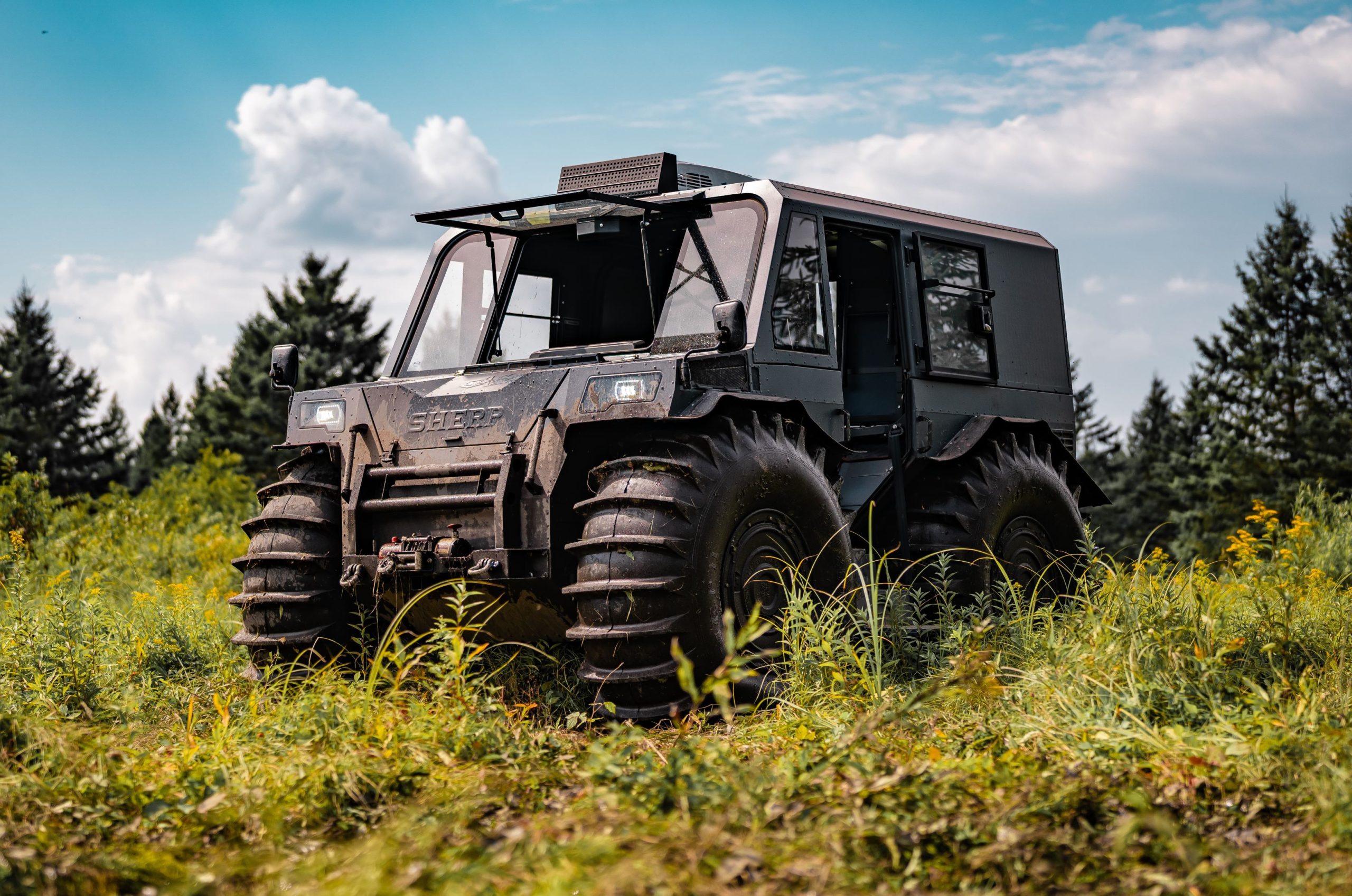
The SHERP N 1200 is specifically engineered around low ground pressure. SHERP lists the N 1200’s ground pressure at approximately 0.9–2.1 pounds per square inch. For context, that is an extremely low pressure range compared with many conventional vehicles.
The SHERP achieves this through its oversized, extra-low-pressure tires. The tires have a large contact patch that helps distribute the vehicle’s weight across the surface. The result is a vehicle designed to travel across soft terrain while minimizing the tendency to sink. This is one of the reasons SHERP can operate in environments such as peat, marshes, sand, moor, snow, and other unstable surfaces.
Ground Pressure vs. Horsepower
More horsepower doesn’t automatically make a vehicle better in soft terrain. Imagine two vehicles traveling through deep mud. One has significantly more horsepower, but its tires have a relatively small contact patch and the vehicle is sinking into the ground. The other has less horsepower but distributes its weight over a much larger area. The more powerful vehicle isn’t necessarily going to win. If the vehicle is constantly sinking, additional engine power may simply result in more wheel spin.
This is why extreme-terrain vehicle design has to consider the entire system rather than focusing on one specification. Engine power matters. Traction matters. Clearance matters. Weight matters. But the vehicle also needs to interact with the ground in a way that allows it to stay mobile.
How Tire Size Affects Ground Pressure
Tire size plays an important role in ground pressure because larger tires can create a larger contact area. The SHERP N 1200 uses 1800 x 600 x 25 tires, measuring approximately 71 x 23 x 25 inches. They are tubeless and designed for extra-low-pressure operation. The oversized tires aren’t simply there to make the vehicle look capable.
Their size and design are fundamental to how the vehicle interacts with difficult terrain. SHERP’s tire system also allows operators to adjust tire pressure as needed, and the four wheels are interconnected as part of the vehicle’s tire inflation system. That ability to manage tire pressure is particularly important when operating across changing surfaces.
Ground Clearance Is Important, Too
Ground pressure isn’t the only measurement that determines whether a vehicle can handle difficult terrain. Ground clearance matters because a vehicle may encounter rocks, logs, uneven ground, or other obstacles that can contact the underside of the machine. The SHERP N 1200 has approximately 600 mm, or 23.6 inches, of ground clearance. It is also designed to overcome obstacles up to approximately one meter in height.
That combination of low ground pressure and substantial ground clearance gives the vehicle two different advantages. The tires help it stay on top of soft terrain, while the vehicle’s clearance helps it navigate larger obstacles without relying on a conventional suspension system.
Why Low Ground Pressure Can Matter for Sensitive Terrain
There are also situations where minimizing ground disturbance is important. Some remote environments are difficult to access because the terrain is soft or sensitive. A vehicle that repeatedly sinks into the surface can leave deep ruts and make the route increasingly difficult for subsequent travel.
SHERP’s published ground-pressure range is one reason the company positions the N 1200 for environments where minimizing pressure on the ground is important. This doesn’t mean an all-terrain vehicle has zero environmental impact. No vehicle does. Rather, low ground pressure can help reduce the tendency of a vehicle to sink deeply into soft surfaces compared with a vehicle carrying a similar load over a smaller contact area.
Why Ground Pressure Matters for Remote Work
Ground pressure becomes particularly important when there isn’t a convenient recovery option. On an established trail, getting stuck may be an inconvenience. In a remote location, it can become a major logistical problem. If a vehicle sinks into mud, peat, marsh, or deep snow, recovering it may require another vehicle, specialized equipment, additional personnel, or significant time.
For industries such as mining, utilities, conservation, telecommunications, emergency response, and other remote operations, maintaining mobility can be just as important as getting from point A to point B quickly. The ability to avoid getting stuck in the first place can make a major difference.
Designing for the Terrain
Ground pressure is ultimately one piece of a much larger engineering equation. A capable extreme-terrain vehicle needs to consider the relationship between its weight, tires, drivetrain, clearance, traction, maneuverability, and power.
The SHERP N 1200 is designed as an integrated system rather than simply a conventional vehicle equipped with oversized tires. Its low-pressure tires, amphibious construction, ground clearance, four-wheel drive, and other design features all contribute to its ability to operate in terrain where conventional vehicles can struggle. That is why ground pressure is worth paying attention to when comparing off-road vehicles. A vehicle doesn’t have to overpower the terrain. Sometimes, the better solution is to design the vehicle so the terrain has less opportunity to stop it.
Choosing an Off-Road Vehicle for Difficult Terrain
If you’re evaluating an off-road vehicle for mud, sand, wetlands, snow, peat, or other soft terrain, don’t stop at horsepower or top speed. Ask how much pressure the vehicle puts on the ground. Look at tire dimensions. Consider the vehicle’s weight and contact area. Check ground clearance. Look at how the vehicle manages tire pressure and how its drivetrain is designed for low-traction environments. These details can tell you much more about real-world mobility than a horsepower number alone.
For the SHERP N 1200, low ground pressure is a foundational part of the vehicle’s design. Combined with oversized low-pressure tires, approximately 23 inches of ground clearance, amphibious capability, and the ability to operate across a wide range of terrain, it is designed to keep moving when the surface underneath it becomes the biggest obstacle.


