
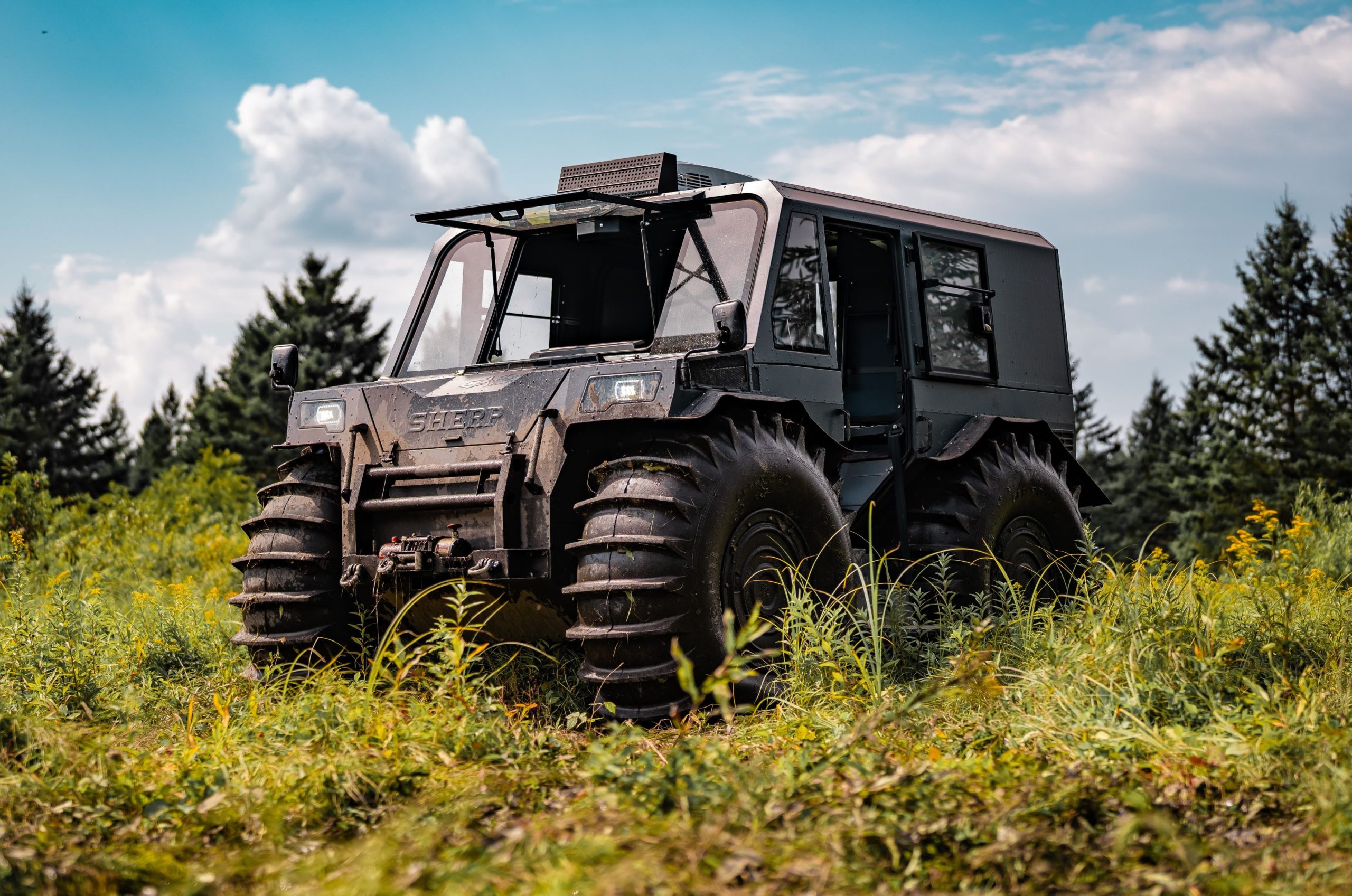


Remote construction projects face challenges that urban and suburban work sites simply don’t encounter. Getting people, materials, and equipment to a location with limited access is often the hardest part of the entire job. Soft ground, deep mud, unpredictable weather, muskeg, uneven terrain, seasonal flooding, and limited pathways can bring a project to a standstill before it even begins. For years, construction companies have attempted to manage these access issues using a mix of ATVs, swamp vehicles, snowmobiles, small boats, and modified 4x4s. While each of those vehicles works well under certain conditions, none of them can handle every condition a remote job site can throw at them.
This is the space where SHERP vehicles have increasingly proven their value. Over the past decade, SHERP has gone from a niche curiosity to a serious asset for companies operating in remote construction, utility work, energy development, forestry, surveying, and infrastructure repair. The reason for that growth is straightforward: SHERP can get crews and materials to places that stop other equipment in its tracks. For project managers who are trying to control costs, avoid downtime, and maintain consistent access to remote job sites, the SHERP has become an incredibly practical solution.
To understand why SHERPs are becoming a go-to vehicle for remote construction, you have to look at the problems construction teams face, and how the SHERP solves them in a way most off-road vehicles simply can’t.
Reliable Access Is Everything in Remote Construction
On most remote projects, access determines everything else: the schedule, the budget, the amount of labor required, and the feasibility of the project itself. A job that should take six weeks can stretch into six months if crews can only reach it during certain weather windows. Roads wash out, ice breaks, heavy equipment sinks into soft ground, and miles of terrain become unusable after a single night of rain or thaw.
Traditional off-road equipment can help, but only to a point. ATVs, UTVs, and trucks still sink into mud and deep snow. Tracked vehicles work well in certain areas, but they’re expensive, slow, and not always practical for transporting crews. Boats require water access and still leave gaps where land transitions into wetlands. Snowmobiles are only useful in winter and often struggle in wet or inconsistent snow.
Remote construction teams need a single vehicle that can move through all of these conditions, without requiring multiple seasonal machines or risking constant recovery operations. SHERP fills that gap by offering year-round, all-condition access that doesn’t rely on stable terrain, perfect weather, or constructed roads.
How SHERP Handles Terrain That Stops Construction Vehicles
A major reason SHERP has become popular in the construction world is simple, the terrain doesn’t have to cooperate. Where most machines require firm ground, predictable surfaces, or a combination of traction and clearance, the SHERP’s engineering removes those dependencies altogether.
The oversized low-pressure tires spread out the vehicle’s weight so effectively that it won’t sink into deep mud, wetlands, or snowdrifts. Instead of digging in, the tires float across the surface, allowing the SHERP to move steadily even when the ground underneath can’t support the weight of a typical truck or ATV. Construction crews no longer have to worry about ruts, washouts, or soft earth slowing down the work.
Another advantage is the SHERP’s high ground clearance. When your job site is full of logs, rocks, debris, uneven ground, or undergrowth, most vehicles need constant route adjustments. SHERP drivers simply keep moving forward. The vehicle climbs over obstacles instead of navigating around them, and its watertight body protects it from hidden hazards under water or deep snow.
Even more useful is the SHERP’s ability to transition seamlessly between land and water. Many remote projects involve river crossings, marshlands, or waterlogged terrain. Normally, crossing these areas requires extra equipment or a detour that costs time. A SHERP simply keeps driving, floats across the water, and climbs out the other side.
For construction crews working miles from roads, this predictability is a major advantage. It eliminates the “wait until conditions improve” downtime that eats budgets and forces schedule changes.
The SHERP Reduces the Need for Multiple Specialized Vehicles
Most remote construction operations rely on several types of vehicles because no single machine can handle every terrain challenge. It’s common to see companies using:
- ATVs or UTVs for light transport
- Snowmobiles for winter access
- Work trucks for stable roads
- Tracked vehicles for deep mud or muskeg
- Skiffs or barges to move tools and materials
Each of these comes with a cost: purchase price, maintenance, fuel, storage, and trained operators. And even with that assortment of equipment, there are still times when sites become inaccessible. A SHERP condenses all of those capabilities into one vehicle. It replaces the need for seasonal machines, reduces the number of vehicles in the fleet, and minimizes the amount of recovery equipment needed. It’s about simplifying operations and reducing the number of points where something can go wrong.
For many companies, the SHERP’s all-season versatility is one of the strongest arguments in its favor. Having one machine that works in mud season, breakup season, winter, and the height of summer removes many of the logistics challenges that slow down remote projects.
A SHERP Minimizes Costly Downtime
In construction, time is money. When crews can’t reach a job site, the entire project stalls. Equipment sits idle, labor hours go to waste, supervisors reschedule tasks, and sometimes subcontractors have to return weeks later when conditions improve. These delays cost far more than the price of a vehicle.
Using SHERP vehicles dramatically reduces these delays. Because the SHERP doesn’t depend on dry ground, packed snow, or a solid road base, access remains consistent even when conditions vary from day to day. Companies that work in northern climates or remote forested areas often deal with constant freeze-thaw cycles, early snow, late snowmelt, or saturated ground. These unpredictable conditions are where SHERPs shine.
A machine that can keep moving regardless of the weather adds predictability to the schedule. It lets crews work when they need to work instead of waiting for nature to cooperate. Over the course of a multi-month or multi-year project, having that reliability often offsets the cost of the vehicle entirely.
Transporting Workers and Materials Safely
Remote construction often requires transporting tools, building materials, fuel, generators, test equipment, and personnel across long distances with no structured roads. SHERPs are designed with that kind of movement in mind. With high payload capacity, ample space for tools and supplies, and the ability to carry multiple workers safely inside an enclosed cabin, the SHERP becomes a dependable shuttle for the entire project.
Crews appreciate that the SHERP rides more steadily across unstable ground than most off-road vehicles. When you’re transporting delicate equipment, survey tools, pipeline parts, or materials that can’t get wet, this stability matters. There’s also a lower chance of rollovers compared to lightweight ATVs or side-by-sides, especially when the ground is uneven or visibility is low.
For companies that routinely move teams across long, difficult terrain, the SHERP improves safety while reducing the number of trips required.
Low Maintenance Requirements Are a Major Cost Advantage
Remote projects don’t have easy access to repair shops. If a vehicle breaks down miles from a road, the cost of recovery can be significant. SHERPs are designed to reduce that risk through a simple, rugged internal structure. The sealed body protects essential components, and the drivetrain avoids many of the failure points common in more complex off-road vehicles.
Construction teams appreciate that SHERPs are easy to service and built to withstand harsh environments. Parts last longer because the vehicle doesn’t dig into mud or fight against the terrain. It floats, rolls, and climbs with minimal strain. This lower wear and tear contributes directly to cost savings over the life of the vehicle.
SHERPs Are Used in Pre-Construction Surveys
Before construction even begins, teams often have to survey the land, collect samples, test soil conditions, and evaluate environmental factors. These early tasks require frequent travel across ground that may be unstable or unpredictable, especially during spring melt or rainy seasons.
Survey crews have embraced SHERP vehicles because they eliminate the need to coordinate multiple machines depending on the terrain. With a SHERP, you can visit every point on the map in one trip, regardless of changes in elevation, water levels, or underfoot conditions.
This reliability helps keep projects on track from the earliest planning stages. It’s often the first point where construction companies realize the vehicle pays for itself.
Why SHERP Is Growing in the Construction Sector
The construction industry tends to adopt new equipment slowly, especially when the price tag is significant. But SHERP adoption has grown steadily because the results are consistent. Companies no longer need to make a bet with off-road conditions or invest in a long list of specialized machines. They can rely on one vehicle that performs across all seasons and terrains.
More importantly, SHERP solves very specific pain points that impact budgets:
- Delays caused by terrain
- Extra labor required for equipment recovery
- Repeated maintenance on seasonal vehicles
- Inefficient transport across long distances
- Limited access during wet or thaw seasons
- The need to buy and maintain multiple machines
When a single vehicle helps eliminate many of these issues, the investment becomes easier to justify.
SHERPs are becoming a go-to vehicle because they solve real, consistent problems that cost companies time and money. Whether the challenge is deep mud, snow, spring breakup, soft ground, or waterlogged terrain, the SHERP provides steady access that other vehicles can’t match.
For construction teams that rely on predictable travel to stay on schedule, the SHERP offers straightforward, dependable performance. It keeps crews moving, reduces risk, and supports the entire life cycle of a remote project.


